How to Get a Sharper Jawline: What Actually Works
A sharper jawline is a structural facial feature that creates a defined border between the lower mandible and the neck. Achieving it requires reducing overall subcutaneous body fat, maintaining proper oral posture, and in some cases, undergoing clinical procedures to alter underlying bone structure for permanent aesthetic changes.
This guide explains how to get a sharper jawline using evidence-based methods, and it is written for men who want real results without the toxic community folklore. We break down the exact steps you need to take, from lowering body fat to clinical options, so you can stop wasting time on internet myths.
The internet is flooded with exaggerated claims about facial restructuring. We will cover the biological limits and the actual mechanisms behind facial aesthetics so you can build a realistic plan.
Step 1: Lower Body Fat to Reveal Your Jawline
The single most effective step for anyone wondering how to get a sharper jawline is reducing overall body fat percentage. Most men who believe they have a weak jawline actually possess normal skeletal structure obscured by subcutaneous fat. The face is a primary area where the male body stores excess adipose tissue.
Spot reduction is biologically impossible. You must maintain a sustained caloric deficit over 8 to 12 weeks to force your body to metabolize stored fat. As you lean out, the skin tightens around the jawbone, naturally enhancing the angularity of your lower face. This systemic approach is the foundation of fitness and body composition.
Nutrition plays a crucial role in managing facial puffiness. High sodium intake leads to water retention, which blurs the jawline. Adhering to the healthy diet fact sheet published by the World Health Organization, which recommends consuming less than 5 grams of salt per day, stabilizes your electrolyte balance.
Cardiovascular exercise accelerates this process by increasing daily energy expenditure. Following the physical activity fact sheet from the World Health Organization, which recommends at least 150 minutes of moderate-intensity exercise per week, supports your metabolic rate.
Consistency in your diet and exercise routine is paramount. By maintaining a steady deficit, you allow your body to steadily oxidize subcutaneous fat, eventually revealing the sharp contours of your mandible.
- Maintain a moderate daily caloric deficit for 8 to 12 weeks.
- Consume less than 5 grams of sodium daily to prevent water retention.
- Commit to at least 150 minutes of cardiovascular exercise per week.
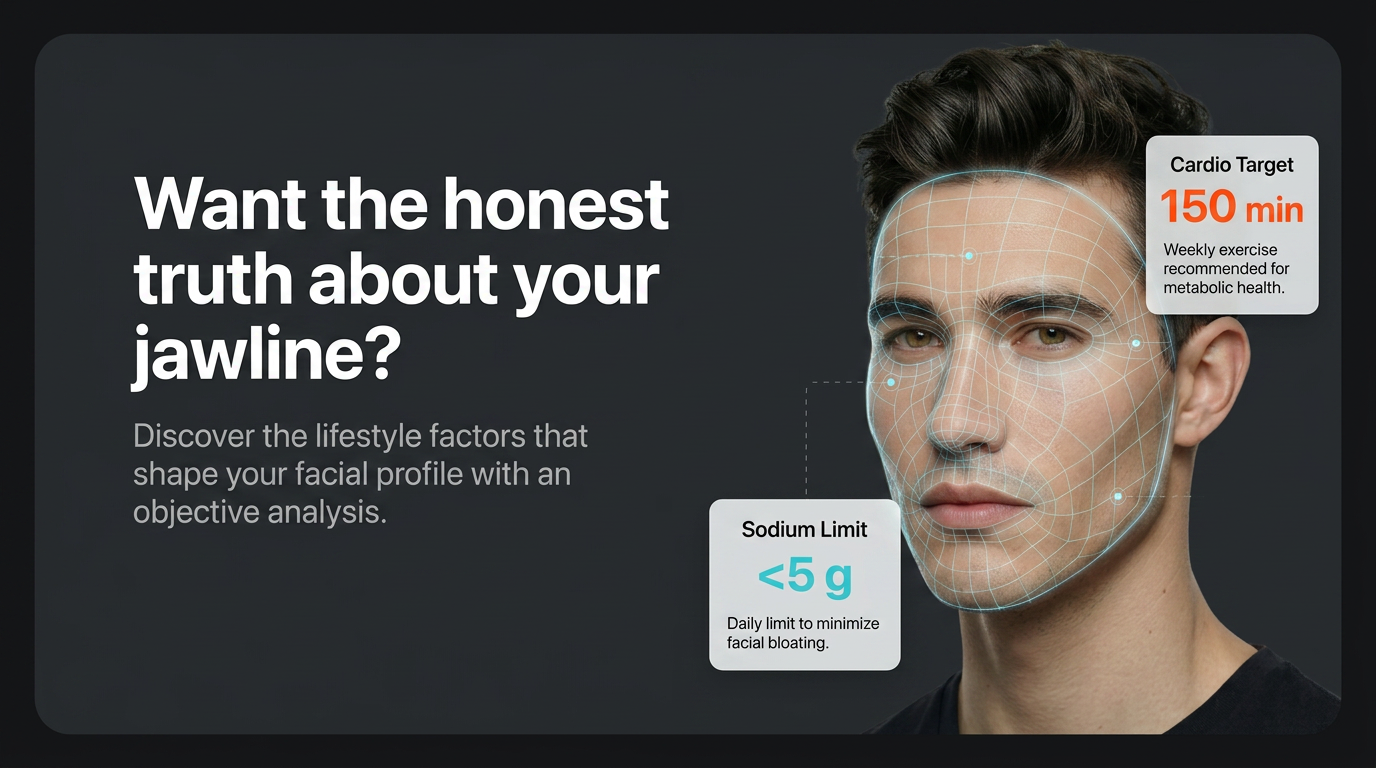
Sodium Limit
<5 g
Daily salt limit recommended by the WHO to prevent water retention.
Cardio Target
150 min
Minimum weekly moderate-intensity exercise recommended by the WHO.
Step 2: Optimize Oral Posture for Soft Tissue Tension
Oral posture refers to the resting position of your tongue, teeth, and lips. The modern community often refers to this practice as Mewing (orthotropics), focused on resting the entire tongue against the roof of the mouth. The premise is that this provides upward structural support to the maxilla and tightens the submental muscles.
While the internet exaggerates the ability of tongue posture to reshape adult bones, the soft tissue benefits are real and immediate. When you engage the posterior third of your tongue against your palate, the hyoid bone is pulled upward. This action instantly tightens the skin under your chin, reducing the appearance of a double chin.
Proper oral posture also encourages nasal breathing. Chronic mouth breathing drops the tongue to the floor of the mouth, which over time contributes to a lengthened facial appearance and poor jaw definition. Transitioning to nasal breathing is a core component of the fundamentals of facial aesthetics.
For adults, this practice should be viewed as muscular conditioning rather than skeletal remodeling. A systematic review and meta-analysis on myofunctional therapy for the treatment of obstructive sleep apnea demonstrates that targeted tongue and facial exercises can significantly alter upper airway muscle tone.
LooxMaxxing
Want to know where you actually stand?
Upload three photos, answer the assessment and get an AI facial rating with a personalized improvement program.
Take the free assessmentStep 3: Build Masseter Volume Through Targeted Chewing
The masseter muscles sit at the rear of your jaw and are responsible for chewing. Like any skeletal muscle, they respond to progressive overload through hypertrophy. By consistently challenging these muscles, you can increase their volume, which adds lateral width to the lower third of your face and creates a more squared appearance.
To stimulate masseter growth, you need resistance. Regular chewing gum is usually too soft to provoke hypertrophy. Many men use mastic gum or specialized tough chewing resins, chewing for 15 to 20 minute sessions every other day. Expect visible changes in 10 to 14 weeks. You must chew evenly on both sides to prevent severe facial asymmetry.
In practice, a common pattern we see is men combining aggressive chewing routines with poor sleep and baseline stress, leading to temporomandibular joint pain rather than aesthetic muscle growth. If you experience clicking, popping, or pain in the joint, you must stop immediately and allow the area to recover.
Adding width to the jaw only improves aesthetics if your body fat is already low. If you have high body fat, growing the masseter muscles will simply make your lower face look rounder and heavier. Focus on fat loss first.
- Chew tough resin or mastic gum for 15 to 20 minute sessions.
- Alternate sides evenly to prevent muscular asymmetry.
- Stop immediately if you experience joint clicking or pain.
Step 4: Consider Clinical Procedures for Structural Jawline Advancement
For men with severe mandibular recession, lifestyle changes and fat loss will not be enough to create a sharp jawline. When the underlying bone structure is physically set back, clinical intervention is the only way to achieve significant, permanent projection. This is deeply rooted in established medical science.
Research on the influence of mandibular prominence on facial attractiveness confirms that a strong jawline is a universal marker of male aesthetics. If your lower jaw is recessed, orthognathic surgery can advance the entire mandible. This procedure corrects functional bite issues while drastically improving structural definition.
In some cases, surgeons utilize a surgery-first approach to orthognathic treatment, which provides immediate improvement in facial aesthetics before lengthy orthodontic work is completed. This allows patients to see the aesthetic benefits of jaw advancement much sooner.
If your bite is normal but your chin is weak, a sliding genioplasty is a more targeted option. A comprehensive review of genioplasty procedures shows that cutting and advancing the chin bone provides a natural, permanent enhancement to the jawline profile.
Step 5: Track Your Jawline Progress with Measurable Checkpoints
Figuring out how to get a sharper jawline is a slow process that requires consistent tracking. Because changes happen gradually, relying on the mirror will deceive you. You must establish objective checkpoints to measure your body fat reduction, muscle growth, and soft tissue changes over time.
Start by taking standardized progress photographs every two weeks. You must use the exact same lighting, camera angle, and focal length each time. Stand in front of a window with natural light hitting your face from the side, as side lighting highlights the shadows cast by your jawbone.
Track your body weight and waist circumference weekly. Since facial fat loss correlates strongly with overall body fat reduction, a shrinking waistline is a primary indicator that your jawline will eventually sharpen. If your weight drops but your face remains puffy, evaluate your sodium intake.
To get a baseline understanding of where you stand, you can take our free face assessment to get a personalized plan. This helps identify whether your primary issue is body fat, muscle volume, or skeletal recession, allowing you to tailor your approach accordingly.
- Take progress photos every 14 days under identical side lighting.
- Track waist circumference as a proxy for overall body fat reduction.
- Monitor your weight weekly to ensure you are in a caloric deficit.
Warning: Avoid Dangerous Trends and Understand Jawline Safety Risks
The looksmaxxing community is notorious for promoting dangerous, unscientific methods for facial enhancement. You must approach jawline improvement with strict adherence to medical safety. The most destructive trend currently circulating is bonesmashing, which involves repeatedly striking the jaw or cheekbones with hard objects under the false belief that micro-fractures will heal into a sharper bone structure.
Maxillofacial surgical consensus, frequently highlighted in clinical critiques of Looksmaxxing, is that repeatedly striking the facial bones causes injury, scarring, and bone resorption rather than aesthetic bone remodeling. Blunt force trauma to the mandible can easily crush the marginal mandibular nerve, leading to permanent facial palsy, chronic pain, and irreversible disfigurement.
DIY orthodontics and hard mewing present another severe risk. Applying immense pressure to your teeth with your tongue or unregulated dental appliances can push your teeth out of alignment and cause severe temporomandibular joint dysfunction. As documented in the background of Mewing (orthotropics), the American Association of Orthodontists strongly advises against using unguided pressure to alter dental arches.
If you believe you have a structural deficiency that requires skeletal changes, you must consult a licensed maxillofacial surgeon or orthodontist. Attempting to force bone remodeling through blunt trauma or extreme pressure will only ruin the facial structure you currently have.
Key Takeaways on How to Get a Sharper Jawline
Learning how to get a sharper jawline is entirely possible, provided you ignore the internet hype and focus on human biology. By systematically addressing fat, muscle, and posture, you can maximize your genetic potential. Understanding where you sit on the PSL scale explained by objective metrics can help set realistic expectations.
For most men, the journey begins in the kitchen and the gym. You cannot build a sharp jawline if it is hidden under a layer of fat. Once you reach a lean baseline, you can assess whether you need to build masseter volume or consider clinical options for bone projection.
What to do next: Start by calculating your daily caloric needs and establishing a moderate deficit to begin leaning out. Practice resting your tongue against the roof of your mouth to immediately improve soft tissue tension. If you are unsure where to focus your efforts first, take our free face assessment to get a personalized plan that targets your specific anatomical needs.
- Commit to a caloric deficit until you reach a lean baseline.
- Maintain proper oral posture to tighten the submental area naturally.
- Chew tough gum carefully to build masseter width, but stop if joint pain occurs.
- Consult a surgeon if your mandible is severely recessed.
- Never attempt bonesmashing or DIY orthodontics under any circumstances.
FAQ
How long does it take to get a sharper jawline?
Visible changes from fat loss typically take 8 to 12 weeks of a consistent caloric deficit. Building masseter muscle volume through chewing also requires consistent resistance training over many weeks before aesthetic changes are noticeable.
Can chewing gum actually improve my jawline?
Yes, chewing tough mastic gum provides resistance training for the masseter muscles. As these muscles grow in volume, they add lateral width to the lower third of the face, making the jawline appear more squared and defined.
Does mewing change your bone structure as an adult?
No, there is no clinical evidence that proper oral posture can remodel adult facial bones. However, resting your tongue on the roof of your mouth immediately tightens the soft tissue under your chin, improving your jawline profile.
Is bonesmashing safe for jawline enhancement?
Absolutely not. Maxillofacial surgical consensus states that striking the facial bones causes micro-fractures, permanent nerve damage, and bone resorption. It is a dangerous internet myth that leads to irreversible disfigurement.
Why is my jawline weak even though I am skinny?
If you have low body fat but lack jawline definition, you likely have a recessed mandible or a weak chin. In these cases, lifestyle changes will not alter the underlying bone, and clinical options like genioplasty or fillers are required for structural advancement.
What is the best exercise for how to get a sharper jawline?
You cannot spot-reduce fat with facial exercises. The most effective exercise for revealing your jawline is cardiovascular training, which increases your daily energy expenditure and helps reduce overall body fat percentage.
LooxMaxxing
Stop guessing. Get your real rating.
Upload three photos, answer the assessment and get an AI facial rating with a personalized improvement program.
Take the free assessmentAbout the author
LooxMaxxing EditorialEditorial
Articles from LooxMaxxing about appearance, grooming, skincare, hair, training and lifestyle.
Keep reading
What Are Hunter Eyes? Anatomy, Genetics and Reality
Discover the anatomy behind hunter eyes, how genetics shape your face, and the honest truth about what you can actually change. Get your personalized plan.
AI Rate My Face: The Honest Truth About Algorithmic Scores
Curious if an ai rate my face tool is accurate? Discover how facial algorithms work, where they fail, and why your score does not define your looks.
Is Mewing Real? What the Clinical Research Actually Says
Wondering is mewing real? We separate clinical facts from internet myths, explain the real risks, and show what actually works for jawline aesthetics.
Medical disclaimer: this article is general information about appearance, grooming and lifestyle habits. It is not medical advice, diagnosis or treatment. Talk to a licensed doctor, dermatologist or dentist before starting any medication, procedure or treatment, and never attempt surgical or orthodontic changes on your own.