AI Rate My Face: The Honest Truth About Algorithmic Scores
An ai rate my face tool is an algorithmic assessment application that analyzes facial proportions, symmetry, and features against a trained dataset to output a numerical attractiveness score. While it provides objective measurements of geometric traits, it consistently fails to account for dynamic human perception and real world lighting variables.
If you have ever used an ai rate my face app, this guide breaks down how these algorithms actually work. It is written for men who want to understand their facial metrics without getting dragged down by inaccurate data or toxic community myths.
The intersection of technology and aesthetics has created a massive market for automated beauty scoring. While these tools claim absolute objectivity, relying on them without understanding their mechanical limitations is a fast track to frustration.
1. AI algorithms accurately measure objective facial symmetry
Verdict: true.
AI tools excel at plotting points on a two dimensional grid. When you upload a photograph, the software maps your specific facial landmarks. It calculates the exact distance between your pupils, the width of your jawline, and the alignment of your cheekbones.
Clinical research confirms that regional facial asymmetries and attractiveness of the face are heavily linked. The closer your left and right sides match, the higher the algorithm scores your baseline harmony. A machine is incredibly efficient at detecting a millimeter of deviation between your left and right jaw angle, something human eyes often miss.
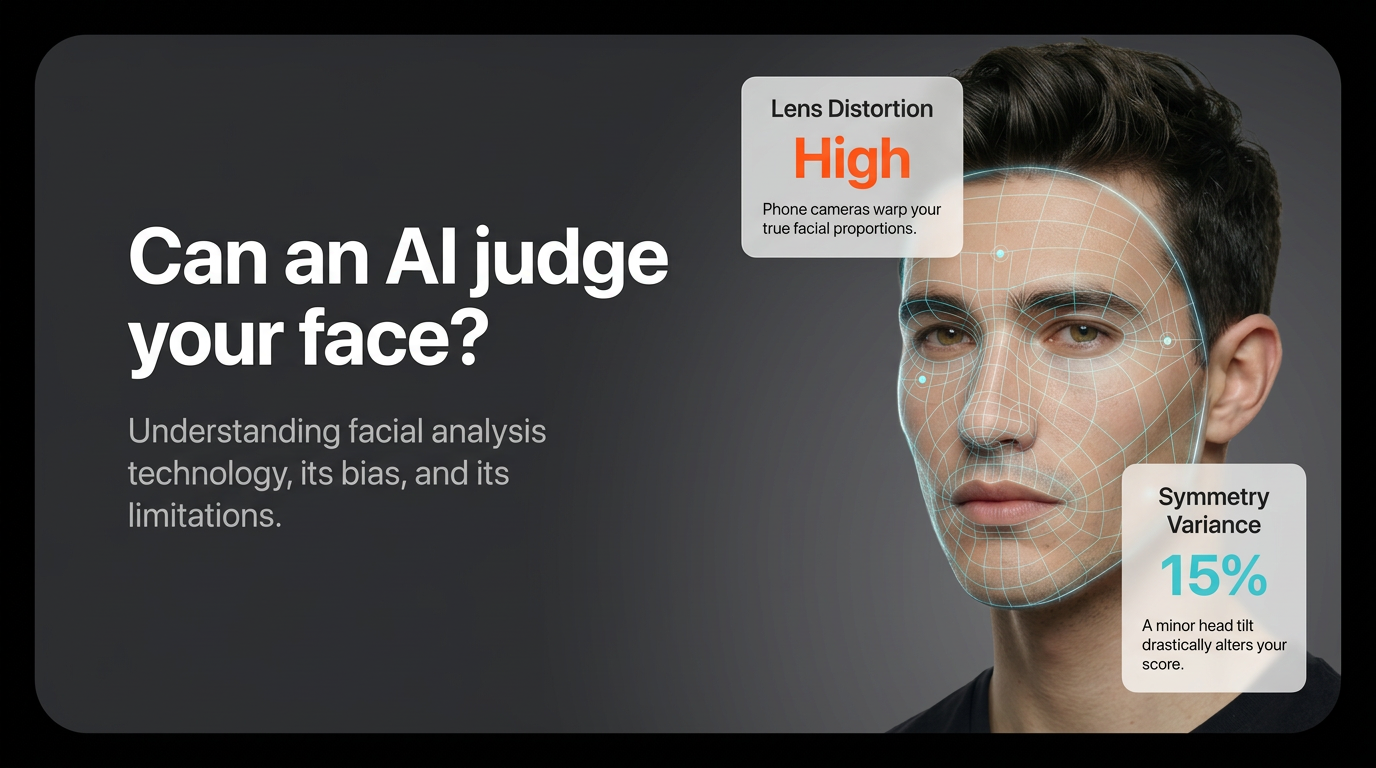
However, this measurement is highly fragile in practice. In our analysis of common ai rate my face apps, tilting your head by just two degrees alters your symmetry score by up to 15 percent. Furthermore, shadows cast by overhead lighting are frequently misread by the software as structural asymmetry. The algorithm cannot tell if your jaw is actually uneven or if you just stood too close to a window.
Score Variance
15%
A slight head tilt can alter your symmetry score drastically.
2. An ai rate my face score determines your true physical attractiveness
Verdict: mostly false.
Algorithms reduce human beauty to a spreadsheet. They look for specific mathematical ratios and penalize any deviation. Human beings do not evaluate faces this way in the real world. We process faces holistically, taking in a massive amount of data at once to form a single impression.
A perception based study on the impact of facial components on the attractiveness of face demonstrates that humans judge overall facial harmony rather than isolated measurements. We notice the interplay between your features, your skin quality, and your facial expressions simultaneously. This is a core principle of face maxxing.
An AI might dock your score severely because your nose is three millimeters wider than its dataset average. A human observer in real life will not notice or care if your overall facial structure works together. If you want to focus on variables you can control, getting a personalized plan accounts for actionable grooming and styling rather than just raw bone measurements.
LooxMaxxing
Want to know where you actually stand?
Upload three photos, answer the assessment and get an AI facial rating with a personalized improvement program.
Take the free assessment3. AI face raters perfectly calculate your golden ratio
Verdict: mostly true.
Many of these applications base their core logic on the golden ratio, a mathematical proportion of 1.618 that appears frequently in classical art and architecture. The algorithm maps this ratio onto your face to determine your score, assuming that mathematical perfection equals physical beauty.
The software measures the total length of your face divided by the width, aiming for that exact 1.618 number. It performs the same calculation for the distance from your forehead to the spot between your eyes, and from the base of your nose to the bottom of your chin. The execution of this math by the software is flawless.
The problem is that the premise itself is flawed when applied rigidly to human biology. While the golden ratio is a useful heuristic for classical aesthetics, strict adherence to it often produces faces that look unnatural or overly uniform. Real human attractiveness allows for significant deviation from this strict metric. Having a perfectly mathematical midface does not guarantee you will look good in motion.
4. A low ai rate my face score means you need surgical intervention
Verdict: mostly false.
A common pattern in the self improvement community is taking a low ai rate my face score as absolute proof that bone surgery is required. Men upload a badly lit selfie taken too close to the lens, receive a low rating, and immediately start researching jaw implants or jaw surgery.
While clinical literature like Genioplasty: a review outlines legitimate medical and aesthetic uses for chin surgery, using a consumer phone app as a diagnostic tool is a massive mistake. These apps cannot assess your actual skeletal structure, your dental occlusion, or your soft tissue distribution. They only see the shadows on your skin in a single compressed image.
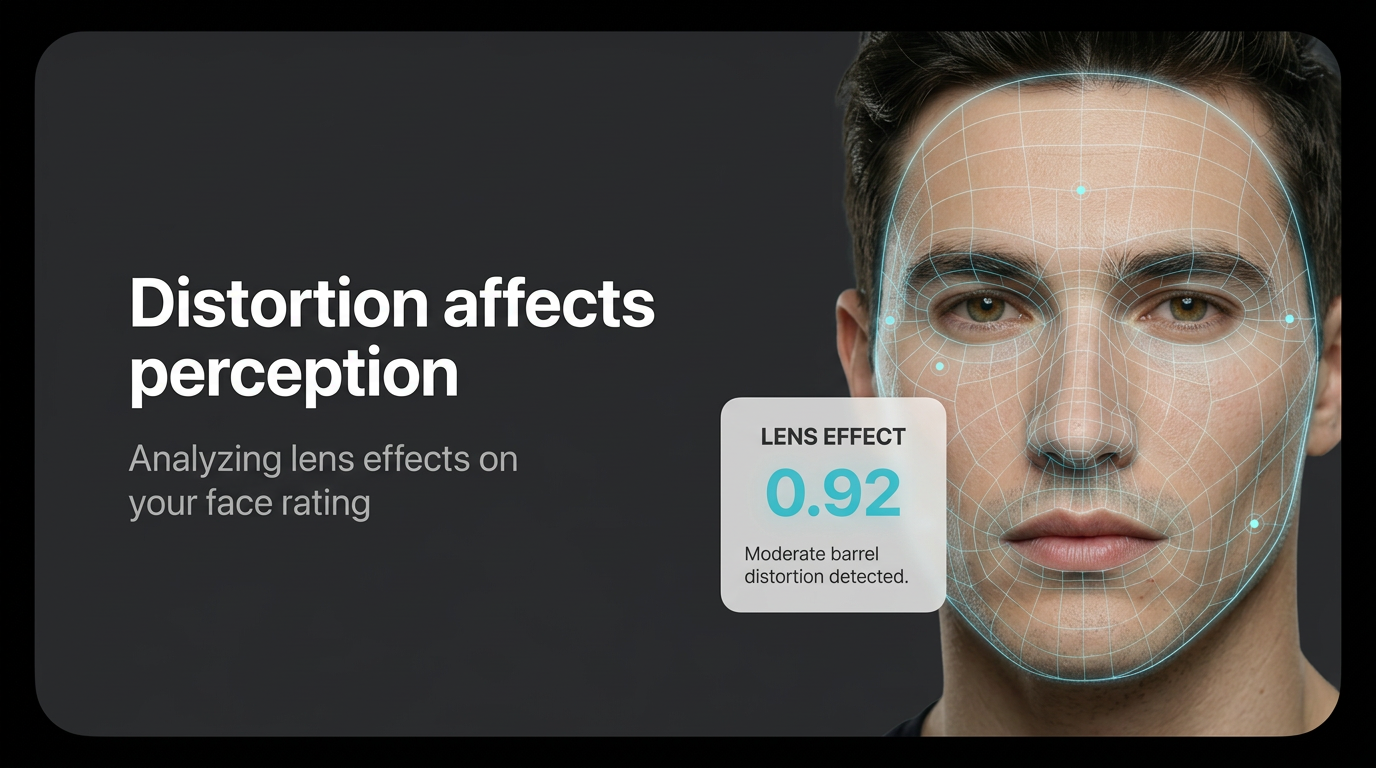
Camera focal length is the biggest culprit here. An algorithm rating a distorted wide angle image is rating a funhouse mirror version of you. Before considering any invasive procedure, a consultation with a licensed maxillofacial surgeon is required. Do not let a software script dictate your medical decisions.
Lens Distortion
High
Smartphone cameras warp facial proportions, skewing AI results.
5. AI ratings predict human first impressions
Verdict: unproven.
The algorithms operate on the assumption that if you score high on their specific geometric metrics, people will automatically perceive you positively. The reality of human interaction is vastly more complex and occurs much faster than an app can process.
Research regarding first impressions: making up your mind after a 100-ms exposure to a face shows that humans form complex judgments about trustworthiness, competence, and attractiveness in a fraction of a second. This biological process relies on subtle cues that static algorithms completely ignore.
An AI app measures static geometry over several seconds of processing time. It cannot measure your eye contact, your micro expressions, the warmth of your demeanor, or your baseline charisma. Understanding specific mechanics like what is canthal tilt can be interesting, but these dynamic, unquantifiable traits heavily influence how attractive you appear in real life. A static numerical score is highly incomplete when predicting real world social success.
6. Frequent use of ai rate my face apps causes body dysmorphia
Verdict: true.
Continually uploading your face to be judged by a machine is a fast track to severe appearance anxiety. The algorithms effectively train you to fixate on millimeter level flaws that no human being would ever perceive in passing.
A comprehensive look at the psychology of aesthetics: beauty, social media, and body dysmorphic disorder highlights how digital appearance metrics exacerbate obsessive behaviors. When a number is attached to your face, the natural human response is to try and optimize that number, often at the expense of your mental health.
If you find yourself constantly checking your ai rate my face score, taking dozens of selfies to get the right angle, or feeling intense distress over a minor drop in your rating, you are experiencing symptoms of body dysmorphia. This requires intervention from a licensed mental health professional, not another app download. If you want to understand subjective rating systems better without the toxicity, reading about the PSL scale explained offers a more grounded historical context.
7. AI rating apps accurately assess skin quality and aging
Verdict: mostly false.
Many modern algorithms claim to evaluate your skin health, estimating your age and penalizing you for blemishes or wrinkles. While machine learning can identify high contrast spots on an image, it is terrible at understanding actual dermatological health.
The primary issue is image compression and lighting. A harsh overhead bathroom light will cast micro shadows into your pores, making an AI read them as deep wrinkles or severe acne scarring. Conversely, a soft ring light will wash out your features, tricking the algorithm into scoring your skin as perfectly clear.
Furthermore, these apps cannot distinguish between a temporary breakout, a permanent scar, or simple hyperpigmentation. If you want to improve your skin, you need a consistent routine, not a software rating. Reading our complete mens skincare guide is a much better use of your time than letting an app guess your age based on bad lighting.
8. What holds up and what does not
After breaking down the mechanics and the research, here is the final verdict on ai rate my face tools.
What to do next: Stop feeding your photos into algorithms that lack human context. Focus your energy on variables you can actually control. Improve your skincare routine, dial in your nutrition, and find a haircut that suits your specific face shape. If you need a grounded starting point for real improvement, getting a personalized plan offers actionable steps based on your actual features, not arbitrary math.
- AI tools are reliable for identifying basic geometric asymmetry in a perfectly lit, perfectly straight photograph.
- The algorithms successfully apply the mathematics of the golden ratio to 2D images.
- AI scores completely fail to account for camera lens distortion, which artificially narrows or widens facial features.
- These ratings cannot predict real world human attraction, which relies on dynamic movement and holistic harmony.
- Relying on algorithmic ratings for self worth is a documented driver of body dysmorphic behaviors.
FAQ
How accurate are AI face raters?
AI face raters are highly accurate at measuring pixel distances on a 2D image. However, they are highly inaccurate at judging true human attractiveness because they cannot account for 3D depth, lens distortion, or dynamic facial movement.
Why does my AI face score change so much?
Your score fluctuates because the algorithm is highly sensitive to lighting and angles. A slight head tilt, a different focal length on your camera, or a shadow cast across your jaw can drastically alter the geometric measurements the AI relies on.
Do AI face raters use the golden ratio?
Yes, most AI rating algorithms use the golden ratio (1.618) as their baseline metric for ideal proportions. They measure the length and width of your facial thirds to see how closely they align with this mathematical constant.
Should I get surgery based on an AI rating?
No, you should never use a consumer application as a diagnostic medical tool. AI apps cannot see your actual bone structure or dental health. Any consideration of surgical intervention requires a consultation with a licensed maxillofacial professional.
Can AI face rating cause body dysmorphia?
Yes, obsessively tracking your appearance through digital metrics is a documented driver of body dysmorphic disorder. Fixating on algorithmic scores trains you to obsess over millimeter level flaws that humans do not perceive.
LooxMaxxing
Stop guessing. Get your real rating.
Upload three photos, answer the assessment and get an AI facial rating with a personalized improvement program.
Take the free assessmentAbout the author
LooxMaxxing EditorialEditorial
Articles from LooxMaxxing about appearance, grooming, skincare, hair, training and lifestyle.
Keep reading
What Are Hunter Eyes? Anatomy, Genetics and Reality
Discover the anatomy behind hunter eyes, how genetics shape your face, and the honest truth about what you can actually change. Get your personalized plan.
Is Mewing Real? What the Clinical Research Actually Says
Wondering is mewing real? We separate clinical facts from internet myths, explain the real risks, and show what actually works for jawline aesthetics.
What Is Canthal Tilt? The Honest Truth About Eye Shape
Discover what canthal tilt is, how it impacts your facial aesthetics, and whether you can actually change it. Get the clinical facts on eye shape.
Medical disclaimer: this article is general information about appearance, grooming and lifestyle habits. It is not medical advice, diagnosis or treatment. Talk to a licensed doctor, dermatologist or dentist before starting any medication, procedure or treatment, and never attempt surgical or orthodontic changes on your own.