The PSL Scale Explained: Meaning, Scores, and How It Works
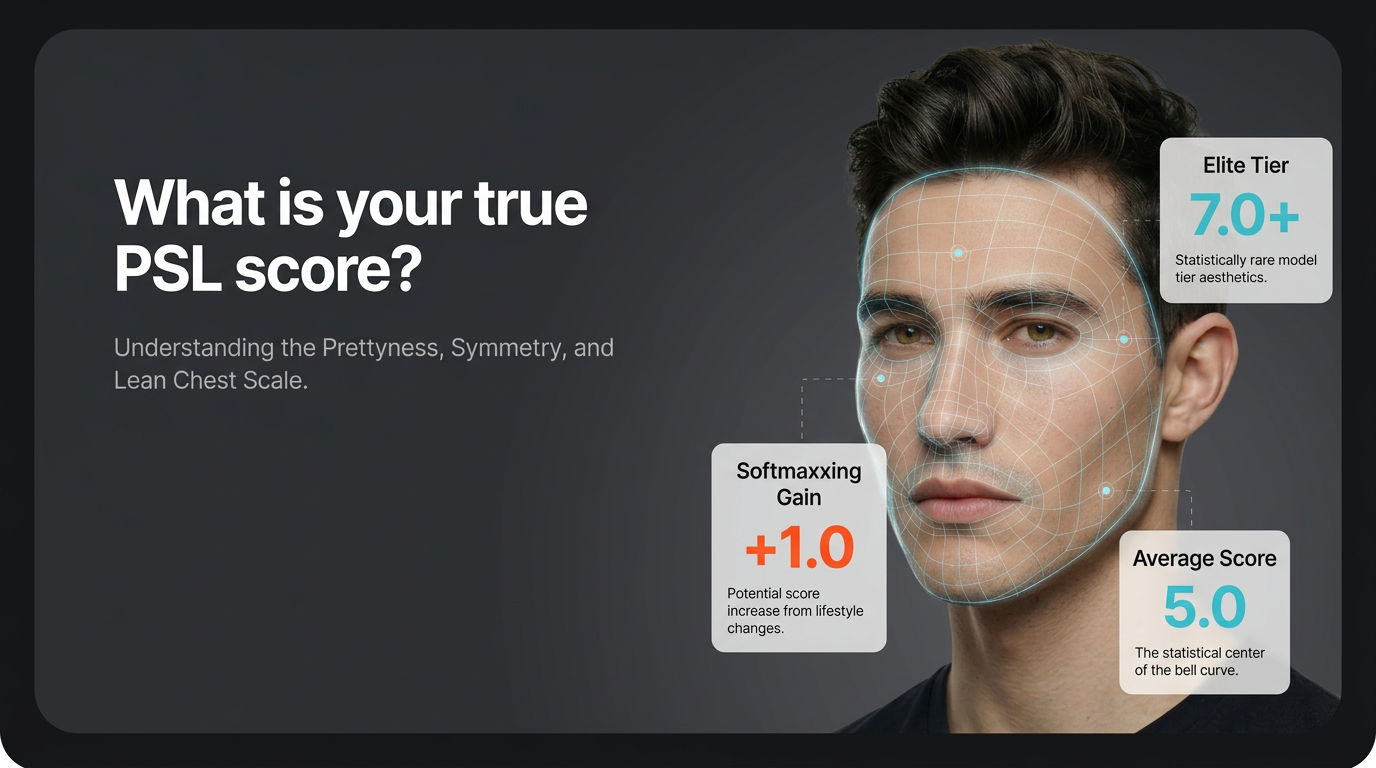
The PSL scale is a rigid facial aesthetics rating system that scores male attractiveness on a strict 1 to 10 bell curve. It measures underlying bone structure, geometric harmony, and facial symmetry while largely ignoring grooming, body composition, and dynamic attractiveness. This framework helps identify structural strengths and weaknesses.
This guide breaks down the PSL scale for men who want to understand how facial aesthetics are objectively rated in the looksmaxxing community. It separates clinical facial analysis from internet folklore to give you a grounded framework for self improvement.
What Is the PSL Scale in Looksmaxxing?
When you first dive into the world of male self improvement, you are immediately hit with a wave of unfamiliar terminology. Grasping the true PSL meaning is often your first major step toward understanding how facial aesthetics are evaluated. Unlike the casual scales you might hear in everyday conversation, the PSL system provides a consistent shared vocabulary. It operates on a strict statistical bell curve, meaning that a 7 on this scale represents top tier model aesthetics, not just a reasonably fit guy at the gym.
The defining characteristic of the PSL scale is its rigid distribution. The vast majority of the human population falls between a 4 and a 6. This is the normal range, which simply means statistically average. To score above a 6 requires exceptional facial harmony, ideal bone structure, and high levels of sexual dimorphism. To score an 8 or above places a man in the elite tier of the global population. This strictness is what makes the scale useful for consistent baseline assessment.
Understanding this bell curve is crucial for your mental health and your improvement strategy. In practice, a casual observer might rate a slightly above average guy an 8 out of 10. The PSL scale corrects this grade inflation. By forcing ratings into a normal distribution, the scale highlights subtle differences in facial features. This allows men to see exactly which traits are holding them back and which traits can be optimized through targeted lifestyle changes.
The purpose of learning this scale is not to obsess over a number or compare yourself unfairly to genetic outliers. Instead, the PSL scale serves as a structured diagnostic tool. By understanding exactly where you stand on a true bell curve of human attractiveness, you can identify your specific weak points. You can set realistic goals and measure your progress accurately as you begin optimizing your health, skincare, and body composition.
The Objective Metrics Behind PSL Scores
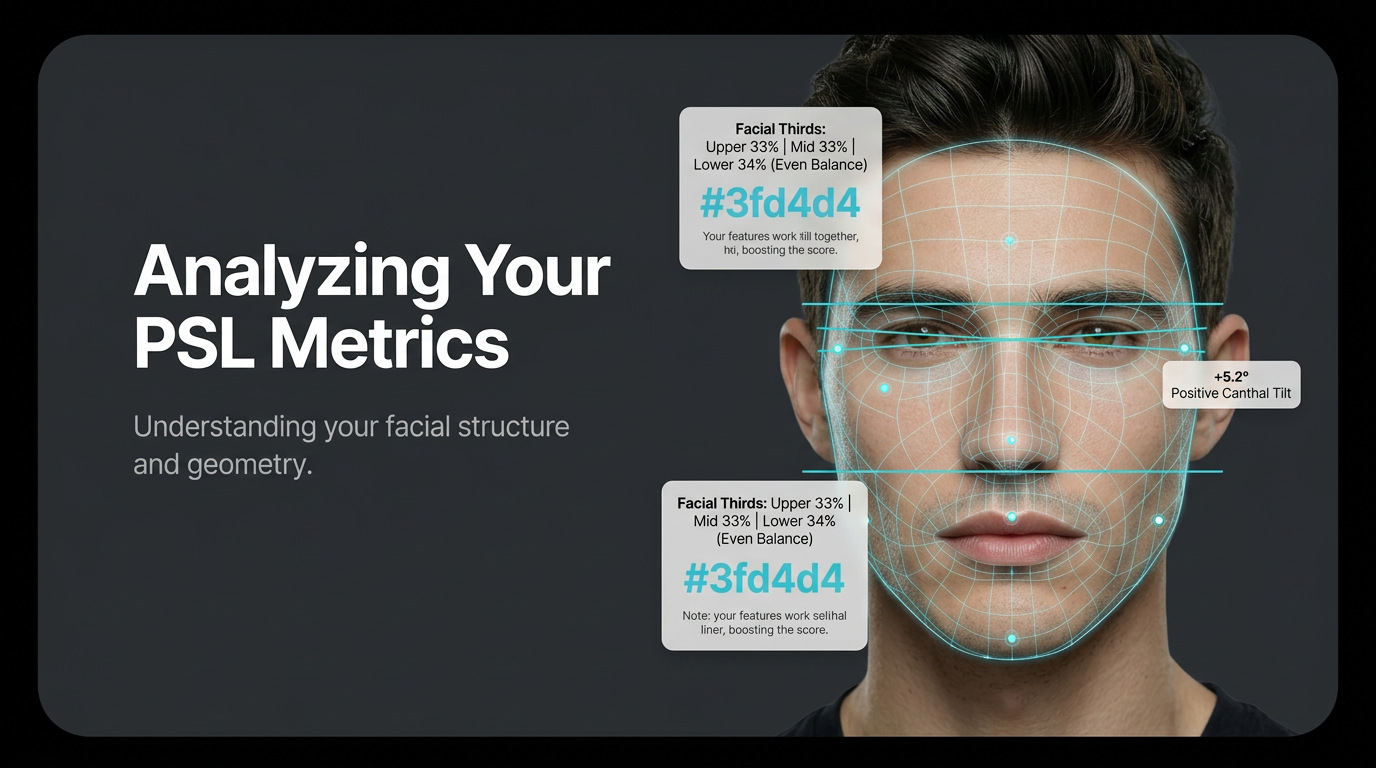
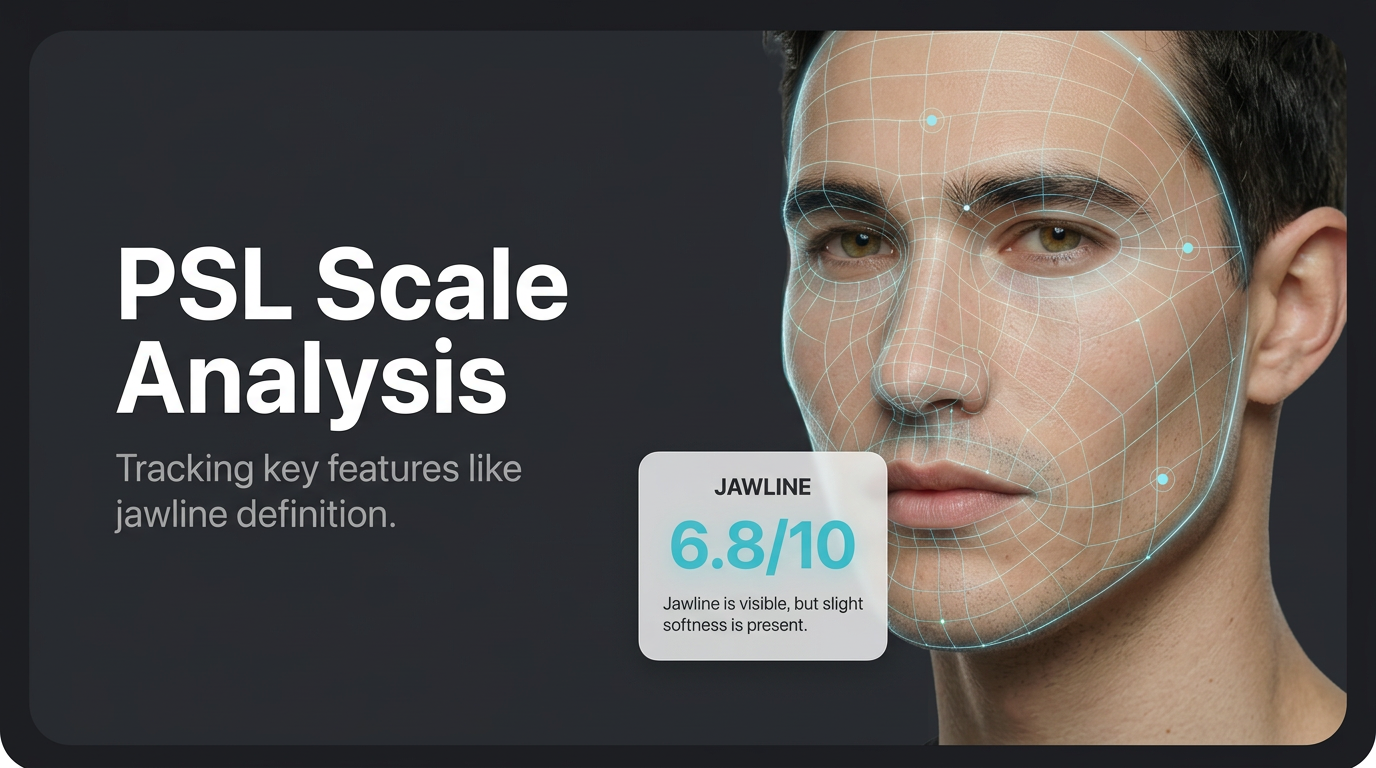
The system evaluates specific geometric markers to determine a score. Key elements include the facial thirds, the bizygomatic width, and the gonial angle. A prominent jawline with an optimal gonial angle scores highly because it indicates strong forward growth. The eye area is another major factor, favoring a positive canthal tilt, minimal upper eyelid exposure, and a dense medial brow. These metrics form the foundation of objective facial analysis.
These concepts are not entirely fabricated by internet forums. Orthodontists and maxillofacial surgeons use similar cephalometric measurements to plan reconstructive surgeries. Evolutionary based research on facial attractiveness confirms that facial symmetry, sexual dimorphism, and average proportions play a significant role in human attraction. Furthermore, a high facial width to height ratio is consistently linked to perceived dominance in male faces.
The speed at which these metrics are evaluated by others is staggering. Research on first impressions shows that people make up their minds about a face after just a 100-ms exposure. This rapid subconscious assessment relies heavily on the geometric markers and symmetry prioritized by the rating system. Your brain processes these structural cues before you even consciously register a person's individual features.
Despite the basis in clinical measurement, the community often takes these concepts to extremes. Orthodontic professionals generally advise against DIY methods like mewing as a jaw restructuring intervention, noting that adult bone structure cannot be altered by tongue posture alone. For reliable information on orthodontic limitations, you must consult a licensed professional. Do not attempt to alter your bone structure using unverified internet methods.
First Impression
100 ms
The time it takes the human brain to form a judgment based on facial appearance.
LooxMaxxing
Want to know where you actually stand?
Upload three photos, answer the assessment and get an AI facial rating with a personalized improvement program.
Take the free assessmentDecoding the PSL 1 to 10 Scale Tiers
To fully understand how to navigate your aesthetic improvement, you must learn the specific tiers within the PSL rating system. These terms are used to categorize where a face sits on the bell curve. View these terms neutrally. They are simply diagnostic categories, not judgments on your worth as a human being. Understanding these tiers helps you set realistic goals for your face maxxing journey.
The Sub-5 Category. This tier refers to individuals who score below a 5.0 on the scale. This usually indicates the presence of significant facial asymmetries, a recessed jawline, or high facial adiposity that obscures bone structure. The good news is that men in this tier often experience the most dramatic improvements. Basic practices like weight loss, proper grooming, and skincare can yield massive results.
The Normie Tiers. This category encompasses the bulk of the population, ranging from 5.0 to roughly 5.75. It is broken down into LTN (Low Tier Normie), MTN (Mid Tier Normie), and HTN (High Tier Normie). An LTN might have a few flaws that detract from their overall harmony, while an HTN possesses solid facial features without glaring weaknesses. Moving from LTN to HTN is a highly achievable goal for most men.
The Chadlite and Chad Tiers. Above the average range are the elite categories. A Chadlite scores roughly 6.0 to 6.5 and is a highly attractive man who stands out in almost any everyday environment. The Chad tier, scoring 7.0 and above, is reserved for elite genetic specimens like high fashion models. These individuals possess near perfect facial symmetry, ideal canthal tilts, and robust jawlines that are statistically rare.
Softmaxxing vs Hardmaxxing: A PSL Rating Comparison
Once you understand your baseline rating, the next step is action. Looksmaxxing is divided into two main categories: softmaxxing and hardmaxxing. Softmaxxing involves non surgical, reversible changes that anyone can implement immediately. Hardmaxxing involves surgical or permanent interventions. Understanding the difference is crucial for managing your expectations and your budget.
For most men, maximizing their softmaxxing potential is enough to ascend one to two full tiers on the scale. Lowering your body fat is often considered the most effective way to reveal facial bone structure. As the fat pads in your cheeks shrink, your jawline will sharpen. Conversely, hardmaxxing carries significant medical risks and financial costs, requiring consultation with a licensed surgeon.
Here is how the most common interventions compare when trying to improve your score:
- Body Fat Reduction (Softmaxxing): Highly effective for revealing bone structure and reducing facial bloating. Verdict: The highest return on investment for any man starting below a 5.5.
- Skincare Routine (Softmaxxing): Clears acne, evens skin tone, and improves texture over several months. Verdict: Essential baseline maintenance that prevents your score from dropping.
- Facial Hair Grooming (Softmaxxing): Artificially enhances jawline projection and chin width. Verdict: A fast, temporary fix to mask a weak lower third.
- Genioplasty (Hardmaxxing): A surgical procedure to advance the chin. A review of genioplasty procedures shows high satisfaction rates for correcting skeletal recession. Verdict: Effective but expensive, requiring a licensed maxillofacial surgeon.
- Orthognathic Surgery (Hardmaxxing): Corrects severe jaw misalignment. Verdict: Strictly a medical procedure for functional issues, not a casual cosmetic fix.
A Realistic PSL Score Worked Example
Worked example: The 16-week softmaxxing protocol. To understand how scores change in reality, let us look at a realistic progression. Assume a 24 year old male starts with a PSL score of 4.5, placing him in the Low Tier Normie category. He has high facial adiposity, moderate acne, and an unkempt beard that rounds out his jawline. His underlying bone structure is mathematically average, but it is entirely hidden by soft tissue issues.
He commits to 150 minutes of moderate aerobic physical activity per week to improve his body composition. In the first 4 weeks, he implements a basic cleanser and moisturizer routine while entering a slight caloric deficit. He loses initial water weight. His facial bloating decreases, but his score remains a 4.5 because the structural changes are not yet visible. He also trims his beard to a uniform length, which immediately creates a cleaner appearance.
By week 8, his cheekbones are becoming slightly visible, and his acne has faded to mild hyperpigmentation. His score edges up to a 4.75. He is now approaching the Mid Tier Normie range simply by revealing the bone structure he already possessed. He has not altered his genetics, but his facial harmony is vastly improved due to the reduction in facial fat.
By week 16, his jawline is now clearly defined, his skin is clear, and his grooming is optimized. His score stabilizes at a solid 5.25, placing him firmly in the Mid Tier Normie category. He has successfully jumped nearly a full point on the scale. This is a realistic, evidence based outcome that requires zero surgical intervention. If you want to see what your own timeline might look like, you can take our free face assessment to get a personalized plan.
Activity
150 min
Weekly moderate aerobic exercise recommended to improve body composition.
What PSL Progress Actually Looks Like
Improving your facial aesthetics is a long game. The internet is filled with false promises of overnight jawline transformations, but biological changes take time. Setting realistic expectations will prevent you from getting discouraged and quitting before the results materialize. Here is what a grounded timeline looks like when you commit to a comprehensive softmaxxing routine.
Weeks 1 to 4: Debloating and Baseline Correction. In the first month, the most noticeable change will be a reduction in facial puffiness. If you cut out excess sodium and alcohol, water retention drops rapidly. Your skin will also begin to purge and adjust to new active ingredients if you have started a proper routine. Do not expect any changes to your perceived bone structure during this phase.
Weeks 5 to 8: Soft Tissue Improvements. By the second month, consistent skincare will yield visible results. Acne should be significantly reduced, and skin texture will smooth out. If you are in a caloric deficit, you may notice the first signs of fat loss around your jaw and neck. This is often the phase where friends and family mention that you look healthier or more rested.
Weeks 9 to 12: Structural Definition. Around the three month mark, true facial leaning occurs. Your cheekbones and jawline will appear sharper as facial fat pads shrink. This is the stage where you might see a genuine increase in your PSL rating.
Weeks 13 to 16: Stabilization. Your results will begin to solidify. To maximize these results, ensure you are following a complete mens skincare routine to keep your skin tight and clear as you lose fat.
Common Mistakes When Calculating Your PSL Meaning
Before you can improve, you must know where you are starting. Finding your accurate baseline requires stripping away your ego and looking at your face through a realistic lens. The biggest mistake men make is rating themselves using a mirror under perfect bathroom lighting. Mirrors flip your face, and dynamic lighting hides asymmetries, giving you a falsely inflated sense of your aesthetic baseline.
Another major error is using a smartphone selfie to judge your facial thirds. Smartphone cameras use wide angle lenses that distort the center of your face. They make your nose look larger and your bizygomatic width appear narrower. To get a real rating, you need a raw, unedited photo taken from roughly 5 feet away with a 50mm focal length to prevent lens distortion.
Human feedback can also be deeply flawed. Friends and family have a well documented tendency toward socially desirable feedback. Conversely, anonymous internet forums carry inherent biases and wildly varying standards. Posting your face on a toxic message board will often result in an artificially low score designed to trigger insecurity. Relying on objective measurements is the only way to find your true starting point.
Finally, a common pattern we see is men fixating on millimeter differences in their canthal tilt while ignoring basic grooming. You cannot change your eye spacing without invasive surgery, but you can clear your acne and improve your body composition today. Focusing on unchangeable genetic traits is a waste of time and energy that should be spent on actionable improvements.
The Psychology of PSL, Mogging, and Mental Health
As you delve into the communities that discuss these ratings, you will inevitably encounter the term mogging. Derived from internet slang, to mog someone simply means to be significantly more physically attractive than them in a side by side comparison. For example, a man with a 6.5 score will naturally draw more visual attention than a man with a 5.0 score if they are standing next to each other.
While visual hierarchy is a reality of human social dynamics, obsessing over it is dangerous. Fixating on rigid scales and comparing yourself to genetic outliers can be psychologically damaging. Exposure to idealized social media images can negatively impact self esteem, according to research on the psychology of aesthetics and social media. Extreme focus on these numbers often leads to severe mental health struggles.
This obsession is closely linked to body dysmorphic disorder, a mental health condition where a person spends a lot of time worrying about flaws in their appearance. These perceived flaws are often unnoticeable to others, but they cause significant distress to the individual. The rigid nature of facial rating scales can easily exacerbate these underlying psychological vulnerabilities.
A clinical review of appearance dissatisfaction and BDD in dermatology highlights that patients often seek cosmetic fixes for psychological issues. If you find yourself obsessing over minor facial asymmetries or considering dangerous DIY procedures, it is time to step away and consult a licensed mental health professional. Surgery cannot fix a psychological fixation.
The healthiest way to use this framework is for self competition. You should only be trying to improve upon the previous version of yourself. By taking structured measurements of your current state, you can systematically apply protocols to climb the tiers. If you start as a Low Tier Normie, your goal should be to reach the Mid Tier, not to instantly become a top tier model.
Is the PSL Scale Scientifically Accurate?
A common question among men entering the looksmaxxing space is whether this rating system has any real scientific validity. The short answer is that while the scale itself is an internet construct, the metrics it uses are grounded in clinical reality. Evolutionary biology has long established that human beings are hardwired to find certain geometric ratios attractive because they signal health, fertility, and genetic fitness.
A comprehensive review of the evolutionary psychology of facial beauty confirms that averageness and symmetry are universal markers of attractiveness across different cultures. The PSL framework heavily penalizes deviations from these averages. For example, a recessed chin or severe facial asymmetry will drastically lower a score. These are the exact same structural issues that maxillofacial surgeons correct to improve both function and aesthetics in patients.
However, the scientific accuracy of the scale fails to account for dynamic attractiveness. The system evaluates a static, two dimensional image. It completely ignores charisma, voice pitch, height, body composition, and social status. In the real world, human attraction is multi sensory and highly contextual. A man with a mathematically average face but excellent social skills and a muscular physique will often outperform a socially awkward man with a higher facial rating.
Furthermore, the extreme strictness of the upper tiers is not entirely reflective of real world dating dynamics. While a mathematically perfect face is statistically rare, it is not a strict requirement for a successful dating life or a high level of perceived attractiveness. The scale is a useful tool for measuring bone harmony, but it should never be viewed as a comprehensive measure of your overall human appeal.
Key Takeaways for Your PSL Aesthetics Journey
Understanding and utilizing this rating scale is an efficient way to approach your aesthetic improvement. By treating your face as a measurable asset, you remove emotion from the equation and focus purely on results. Keep the scale in perspective and avoid the toxic pitfalls of internet echo chambers.
What to do next: Stop obsessing over forum ratings and start taking action. Get a personalized plan by taking our free face assessment to identify actionable areas for improvement. Focus your energy on hitting the gym, clearing your skin, and optimizing your grooming routine to maximize your genetic potential. If you want to learn more about enhancing your lower third safely, read our guide on how to get a sharper jawline.
- The PSL scale is a strict 1 to 10 rating system based on a mathematical bell curve.
- Most men fall into the average tier (5.0 to 5.75), which is a completely normal and solid baseline for improvement.
- Facial metrics like jawline definition, canthal tilt, and symmetry heavily dictate your objective score.
- Improving body composition is the fastest, most reliable way to reveal bone structure and improve your rating.
- Always use structured tools or standardized photos to find your true baseline, rather than relying on distorted selfies or biased forum comments.
- Never attempt unverified DIY bone restructuring methods; always consult a licensed professional for structural concerns.
FAQ
What is a good score on the PSL scale?
A score between 5.5 and 6.0 is considered highly attractive in everyday life. Anything above a 6.0 places you in the top tier of male aesthetics, while an 8 is statistically rare.
What does a 5.1 PSL score mean?
A 5.1 sits at the low end of the normie range (5.0 to roughly 5.75), usually called LTN or low MTN. It describes average facial harmony with one or two features holding the score back. This is the range where lower body fat, grooming and skincare tend to show the biggest visible gains.
Is 5.8 a good PSL score?
Yes. A 5.8 sits just above the high tier normie (HTN) range and just below chadlite (roughly 6.0 to 6.5), which in forum terms means a clearly above-average face without glaring weaknesses. PSL is an informal forum scale, not a validated scientific measure, so treat any decimal score as a rough estimate.
Can you actually increase your PSL rating?
Yes. While you cannot change your genetics, lowering your body fat, clearing your skin, and optimizing your grooming can increase your score by up to a full point.
What does PSL stand for in looksmaxxing?
The acronym originally stood for Puahate, Sluthate, and Lookism, which were early internet forums. Today, the term simply refers to the strict 1 to 10 bell curve rating system used by the community.
Is the PSL scale scientifically accurate?
The scale itself is a community invention, but it relies on real cephalometric measurements. It accurately measures bone harmony and symmetry, though it ignores dynamic attractiveness and soft tissue health.
What is a Sub-5 on the PSL scale?
A Sub-5 refers to a score below 5.0, indicating below average facial aesthetics. Men in this tier often have correctable flaws like high body fat, poor skin, or unkempt grooming.
How do I find my true PSL score?
To get an accurate rating, use a raw, unedited photo taken from 5 feet away with a 50mm lens. Avoid bathroom mirrors and wide angle smartphone selfies, as they distort your facial proportions.
What is the difference between an LTN and an HTN?
LTN stands for Low Tier Normie (roughly 4.0 to 4.5), while HTN stands for High Tier Normie (5.5 to 5.75). Moving from LTN to HTN is highly achievable through basic softmaxxing protocols.
Does mewing improve your PSL score?
There is no clinical evidence that mewing can alter adult bone structure. Orthodontic professionals advise against using tongue posture as a DIY jaw restructuring intervention.
LooxMaxxing
Stop guessing. Get your real rating.
Upload three photos, answer the assessment and get an AI facial rating with a personalized improvement program.
Take the free assessmentAbout the author
LooxMaxxing EditorialEditorial
Articles from LooxMaxxing about appearance, grooming, skincare, hair, training and lifestyle.
Keep reading
What Are Hunter Eyes? Anatomy, Genetics and Reality
Discover the anatomy behind hunter eyes, how genetics shape your face, and the honest truth about what you can actually change. Get your personalized plan.
AI Rate My Face: The Honest Truth About Algorithmic Scores
Curious if an ai rate my face tool is accurate? Discover how facial algorithms work, where they fail, and why your score does not define your looks.
Is Mewing Real? What the Clinical Research Actually Says
Wondering is mewing real? We separate clinical facts from internet myths, explain the real risks, and show what actually works for jawline aesthetics.
Medical disclaimer: this article is general information about appearance, grooming and lifestyle habits. It is not medical advice, diagnosis or treatment. Talk to a licensed doctor, dermatologist or dentist before starting any medication, procedure or treatment, and never attempt surgical or orthodontic changes on your own.