Is Mewing Real? What the Clinical Research Actually Says
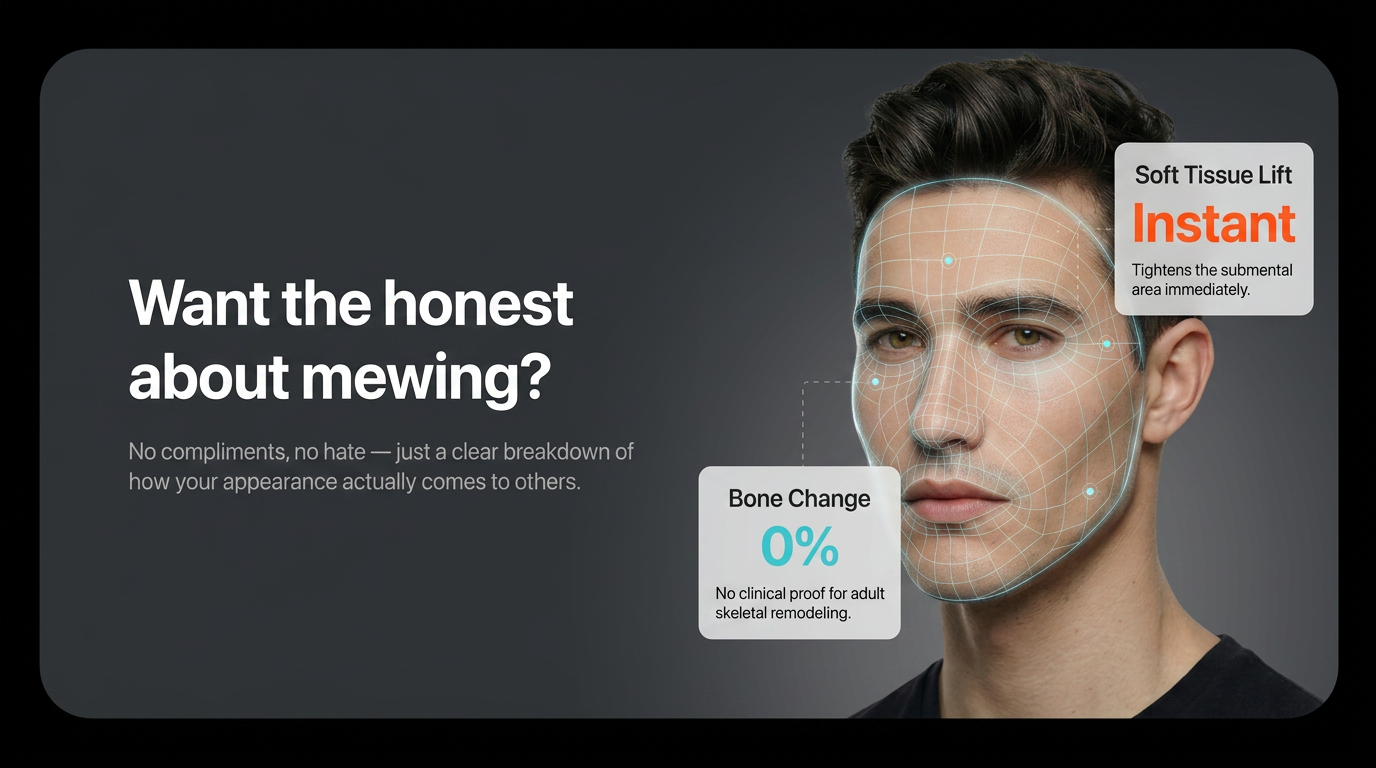
When people ask is mewing real, they are usually referring to a DIY oral posture technique that involves resting your entire tongue on the roof of your mouth to theoretically expand the jaw. While it temporarily tightens submental soft tissue, there is no peer-reviewed clinical evidence that it remodels adult bone.
For anyone asking is mewing real, this guide breaks down the clinical facts versus internet folklore about tongue posture. It is for men tired of exaggerated before-and-after photos who want to understand the actual science of facial aesthetics.
If you are looking for a magic pill to fix your lower third, you will not find it here. We are going to look at the anatomy, the clinical evidence, and the surgical realities of facial aesthetics to determine what actually works.
1. Claim: Is Mewing Real for Reshaping Adult Jaw Bones?
Verdict: mostly false. The core claim of the orthotropics community is that resting your tongue on the palate expands the maxilla. In children, this mechanism has some biological basis because the midpalatal suture is open.
However, in adults, this suture fuses completely between age 16 and 18. Once fused, pressing a soft muscle against the roof of your mouth does not generate the continuous, high-load force required for skeletal remodeling.
According to the clinical overview of Mewing (orthotropics), there is no credible scientific literature supporting the idea that adults can change their skeletal jaw structure through tongue posture alone. Bone requires immense mechanical stress to change shape, which the human tongue cannot provide.
Bone Remodeling
0%
No clinical evidence of adult skeletal change.
2. Claim: Proper Oral Posture Instantly Sharpens Your Jawline
Verdict: true. While asking is mewing real for bone growth yields a negative answer, it does have a real, instant impact on neck soft tissue. The tongue is a massive muscle complex attached to the hyoid bone in your throat.
When you press the posterior third of your tongue flat against the roof of your mouth, you physically lift the hyoid bone. This action pulls the submental tissue upward and tight, creating a sharper angle between your neck and jawline.
In our analysis of community progress photos, a common pattern emerges: postural changes and lighting account for almost all dramatic adult transformations. The person is simply flexing the muscle. To see your baseline without posture tricks, take our free face assessment to get a personalized plan.
Soft Tissue Lift
Instant
Hyoid elevation immediately tightens the submental area.
LooxMaxxing
Want to know where you actually stand?
Upload three photos, answer the assessment and get an AI facial rating with a personalized improvement program.
Take the free assessment3. Claim: The Safety Risks of DIY Orthodontics Are Overblown
Verdict: mostly false. The community often frames tongue posture as a completely natural habit. This is a dangerous misconception. According to the clinical overview of Mewing (orthotropics), maxillofacial surgical consensus and warnings from the American Association of Orthodontists indicate that relying on unproven DIY orthodontics carries severe risks.
The primary danger is temporomandibular joint (TMJ) dysfunction. When people try to force their tongue against their palate, they frequently clench their teeth. Chronic clenching leads to severe jaw pain, accelerated enamel wear, and masseter muscle spasms.
Furthermore, incorrectly pushing the tongue against the front teeth causes incisors to flare outward, creating an open bite. If you experience jaw pain or shifting teeth, you must consult a licensed professional immediately.
4. Claim: Mewing Is a Legitimate Treatment for Sleep Apnea
Verdict: true. The foundational mechanics of mewing are rooted in a legitimate medical practice called myofunctional therapy. Weak tongue posture can cause the tongue to fall back into the airway during sleep, leading to obstructive sleep apnea.
A systematic review and meta-analysis on myofunctional therapy found that strengthening the tongue and facial muscles significantly improves outcomes for patients with sleep apnea. Clinical protocols usually involve specific exercises for 15 to 30 minutes a day.
Training your tongue to rest on your palate is excellent for airway health. It has real medical backing for respiratory function. It just will not give you a square jaw or fix a recessed chin.
5. Claim: Surgical Options Are the Only Way to Alter Bone Structure
Verdict: true. If your goal is a permanent, skeletal change to your lower third, surgical intervention is the only evidence-based route for adults. Orthodontics can move teeth, but they cannot move the underlying foundation once growth has stopped.
Orthognathic surgery physically cuts and advances the maxilla and mandible. For purely aesthetic improvements to the chin, a clinical review of genioplasty demonstrates that surgical advancement of the chin bone provides predictable, permanent improvements to facial harmony.
These procedures involve cutting the bone and securing it with titanium plates. The initial recovery takes 6 to 12 weeks. To understand how the lower third fits into overall proportions, review our guide on facial aesthetics.
Surgical Recovery
6-12 wk
Initial bone healing timeline for genioplasty.
6. Claim: Mandibular Prominence Drives Overall Attractiveness
Verdict: true. The community obsession with jawlines is rooted in actual data. A strong, forward-grown jaw is a universal marker of dimorphic development and health.
Clinical research on the influence of mandibular prominence shows that a well-defined jaw significantly impacts how facial aesthetics are perceived. A recessed chin is consistently rated as less attractive across diverse populations.
However, the jawline is just one component. A perception-based study on facial components highlights that the eyes, skin quality, and overall facial symmetry often carry equal or greater weight. Fixating on a single feature is a common failure mode in self-improvement.
7. Claim: Weight Loss Can Mimic the Results of Mewing
Verdict: true. The most dramatic jawline transformations seen online are rarely the result of bone remodeling. Instead, they are almost always the byproduct of significant fat loss.
When a person reduces their overall body fat percentage, the skin tightens around the existing bone structure. This reveals the natural contours of the mandible that were previously hidden by adipose tissue.
According to the World Health Organization healthy diet fact sheet, maintaining a caloric deficit through proper nutrition is the only reliable way to reduce body fat. Dropping from 20% to 12% body fat will do more to sharpen your jawline than any amount of tongue posture.
8. Claim: Oral Posture Will Transform Your Face in Six Months
Verdict: unproven. The internet is filled with claims that mewing will transform your face in six months. In reality, when evaluating if is mewing real for quick aesthetic gains, the timeline for any visible change is entirely dependent on soft tissue, not bone.
If you are practicing myofunctional therapy to improve muscle tone and airway health, clinical studies suggest it takes 6 to 12 months of consistent daily exercises to see functional improvement. Aesthetically, the results are instantaneous because they rely on flexing the hyoid muscle. The moment you relax your tongue, the soft tissue drops back down.
The most common failure mode is asymmetrical pressure. In practice, most people do not have perfectly symmetrical palates or muscle control. Pushing harder on one side of the palate can exacerbate muscle imbalances, leading to a lopsided appearance. If you want a comprehensive look at other features you can optimize, explore what is canthal tilt.
9. Claim: Chewing Hard Gum Enhances the Effects of Mewing
Verdict: mostly false. A common piece of community folklore is that combining tongue posture with aggressive chewing of hard resins like mastic gum will accelerate jaw expansion. The theory is that hypertrophied masseter muscles will pull on the bone and stimulate growth.
While chewing hard gum will absolutely build the masseter muscles, giving the illusion of a wider lower face, it does not change the underlying bone. The masseters are attached to the mandible, and increasing their size simply adds muscle volume to the sides of your jaw, similar to how lifting weights builds a bicep.
The risk here is significant. Aggressive chewing places immense strain on the temporomandibular joint. Overloading this joint with excessively hard materials can lead to cartilage degradation and chronic pain. Building the masseters is a valid aesthetic goal, but it must be done with moderation.
Summary: What Holds Up and What Does Not
The reality of oral posture is much less glamorous than the internet makes it out to be. When deciding is mewing real for your goals, remember that it has legitimate health benefits, but it is not a substitute for genetics or surgery.
Here is the grounded truth about tongue posture:
What to do next: Stop obsessing over your palate and focus on variables you can actually control. Lowering your body fat percentage through a caloric deficit and consuming 1.6 to 2.2 g of protein per kg of bodyweight will do more for your jawline definition than years of tongue posture. If you want actual structural definition, read our guide on how to get a sharper jawline. To get a data-driven look at your current baseline, take our free face assessment to get a realistic, personalized plan.
- True: Tongue posture lifts the soft tissue under your chin instantly.
- True: Myofunctional therapy is a valid, evidence-based treatment for airway issues.
- False: Pressing your tongue against your palate will remodel fused adult bone.
- False: DIY orthodontics are completely safe and risk-free.
- True: Surgical genioplasty and orthognathic surgery are the only proven ways to alter adult bone structure.
FAQ
Can mewing change your bone structure if you are over 18?
No. By age 16 to 18, the midpalatal suture fuses. There is no clinical evidence that tongue pressure can generate the mechanical force required to remodel fused adult bone.
Why do my jawline before and after photos look so different?
Proper tongue posture lifts the hyoid bone, which tightens the soft tissue and fat under your chin. This creates a temporary, immediate illusion of a sharper jawline, but it is a muscle flex, not a bone change.
Is mewing dangerous for my teeth?
It can be. Pressing your tongue against your front teeth instead of the roof of your mouth can cause your incisors to flare outward. Additionally, clenching your jaw while doing it can lead to severe TMJ dysfunction.
How long does it take for myofunctional therapy to work?
For functional airway improvements and sleep apnea treatment, clinical protocols usually require 6 to 12 months of consistent daily exercises. It will not, however, change your skeletal appearance.
What actually works for getting a better jawline?
For adults, reducing overall body fat is the most effective non-surgical method to reveal your existing jawline. If the underlying bone is severely recessed, orthognathic surgery or genioplasty are the only permanent structural solutions.
LooxMaxxing
Stop guessing. Get your real rating.
Upload three photos, answer the assessment and get an AI facial rating with a personalized improvement program.
Take the free assessmentAbout the author
LooxMaxxing EditorialEditorial
Articles from LooxMaxxing about appearance, grooming, skincare, hair, training and lifestyle.
Keep reading
What Are Hunter Eyes? Anatomy, Genetics and Reality
Discover the anatomy behind hunter eyes, how genetics shape your face, and the honest truth about what you can actually change. Get your personalized plan.
AI Rate My Face: The Honest Truth About Algorithmic Scores
Curious if an ai rate my face tool is accurate? Discover how facial algorithms work, where they fail, and why your score does not define your looks.
What Is Canthal Tilt? The Honest Truth About Eye Shape
Discover what canthal tilt is, how it impacts your facial aesthetics, and whether you can actually change it. Get the clinical facts on eye shape.
Medical disclaimer: this article is general information about appearance, grooming and lifestyle habits. It is not medical advice, diagnosis or treatment. Talk to a licensed doctor, dermatologist or dentist before starting any medication, procedure or treatment, and never attempt surgical or orthodontic changes on your own.