What Is Canthal Tilt? The Honest Truth About Eye Shape
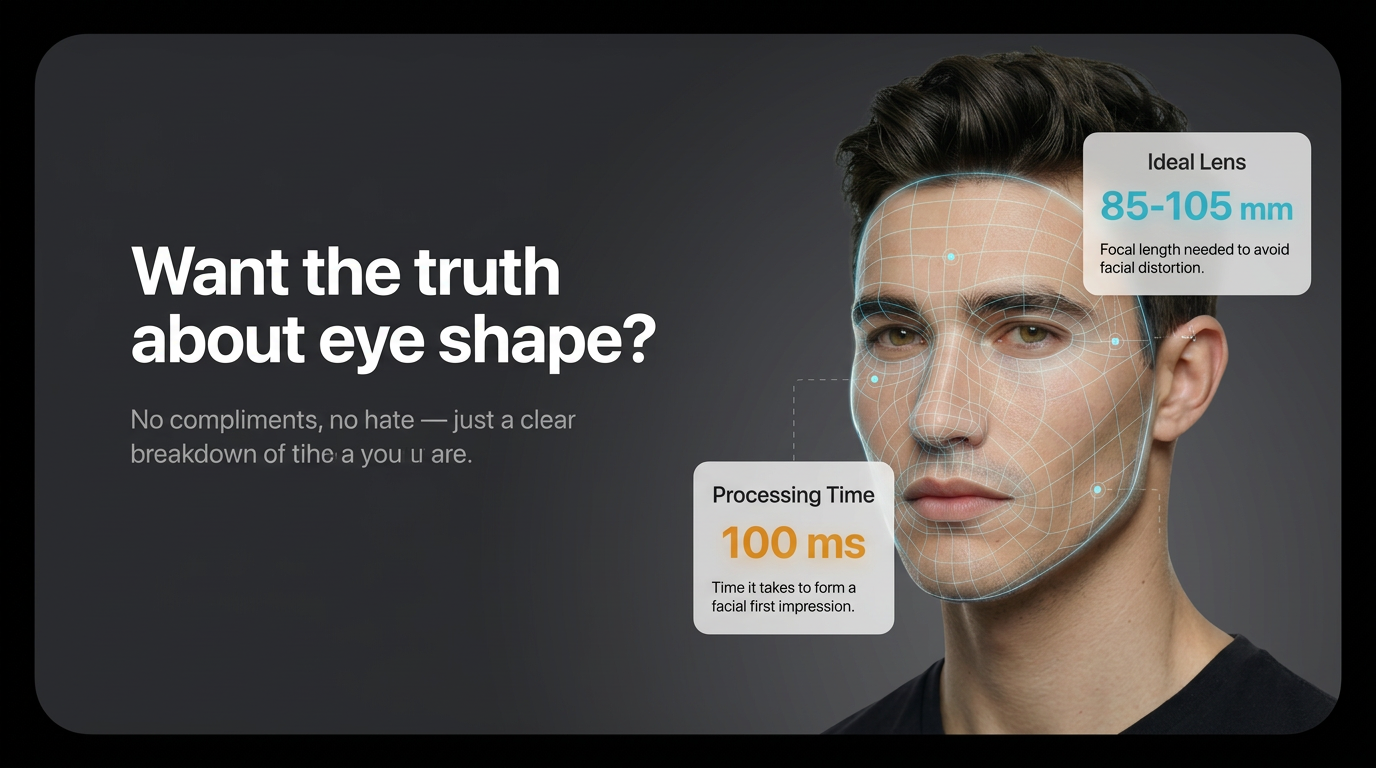
Canthal tilt is the anatomical angle created by drawing a horizontal line between the inner corner and the outer corner of your eye. A positive tilt means the outer corner sits higher, which signals youthfulness. A negative tilt means the outer corner points downward, often creating a tired appearance.
This guide explains the anatomy of canthal tilt, how it impacts your facial aesthetics, and whether you can actually change it. It is written for men who want to separate internet folklore from clinical facts about eye shape and facial structure.
Many online communities treat the angle of your eyes as the ultimate deciding factor in attractiveness. We are going to break down the anatomy, the evolutionary psychology behind eye shapes, and what clinical evidence actually says about altering your bone structure.
The Anatomy Behind Your Eye Angle
Canthus refers to the anatomical corner of the eye where the upper and lower eyelids converge. Every human eye has an inner corner, known as the medial canthus, and an outer corner, known as the lateral canthus. Canthal tilt is the specific geometric angle formed by drawing an imaginary straight line connecting these two distinct points across your face.
A positive tilt occurs when the lateral canthus sits geographically higher on the face than the medial canthus. A neutral tilt means both corners rest on the exact same horizontal plane. A negative tilt happens when the lateral canthus drops below the level of the inner corner, angling downward toward the cheekbone.
This angle is not determined by muscle tone or skin tightness. It is anchored by dense physical ligaments. The lateral canthal tendon attaches directly to the periosteum, the dense connective tissue covering the bone of your lateral orbital rim. The structural positioning of this bone and the natural tension of the tendon are dictated entirely by your genetic blueprint.
You cannot stretch, massage, or train these ligaments to change their anchor points naturally. The tendon is designed to hold the eyeball securely within the orbit and maintain the structural integrity of the eyelid. Any attempt to alter this angle without surgical intervention ignores the fundamental reality of human facial anatomy.
Common Mistakes When Measuring Canthal Tilt
In practice, a common pattern we see is guys attempting to measure their eye angle using smartphone selfies taken at arm's length. This leads to massive anatomical inaccuracies and unnecessary anxiety. Smartphone cameras utilize wide-angle lenses, typically around 24mm to 28mm. These lenses inherently distort the center of the face and pull the outer edges downward.
If you take a selfie from six inches away, barrel distortion will make your eyes appear significantly more negatively tilted than they actually are in reality. To get an accurate measurement, you need a photograph taken from at least five feet away with a standard or telephoto lens, ideally between 85mm and 105mm.
The Frankfort horizontal plane. Your head must be perfectly level when the photo is taken. In clinical settings, this means aligning your Frankfort horizontal plane so it is perfectly parallel to the floor. This plane is an imaginary line passing from the bottom of your eye socket to the top of your ear canal. If your chin is tilted even slightly upward or downward, the perceived angle of your eyes will shift dramatically.
Misidentifying the canthus. Another frequent error is measuring from the outer edge of the eyelashes rather than the actual anatomical corner where the eyelids meet. Once you have a distortion-free image, draw a horizontal line through the medial canthus and measure the angle to the lateral canthus. For most men, a slight positive tilt is the anatomical norm. If you want a realistic baseline of where your facial features stand without relying on distorted selfies, start by getting a personalized plan.
LooxMaxxing
Want to know where you actually stand?
Upload three photos, answer the assessment and get an AI facial rating with a personalized improvement program.
Take the free assessmentThe Evolutionary Psychology of Eye Shape
The modern fixation on eye shape largely originated from online communities focused on male self-improvement. In these spaces, a positive tilt is often categorized as a mandatory component of the ideal male face. The community treats this specific trait as a primary indicator of masculine attractiveness, obsessing over millimeter differences and pathologizing normal variations.
There is a scientific basis for why human beings prefer certain eye shapes. Research on the evolutionary psychology of facial beauty suggests that we are biologically hardwired to recognize and favor physical signs of youth, health, and vitality. A positive tilt mimics the taut, lifted skin and strong bone support associated with high collagen levels and peak physical condition.
Conversely, the natural aging process causes the lateral canthus to droop as ligaments lose their tension and orbital fat pads descend. We process these geometric signals incredibly fast, often without conscious thought. According to a study on making up your mind after a 100-ms exposure to a face, humans form complex judgments about fatigue, age, or vitality in a fraction of a second.
In that brief window of perception, drooping outer eye corners subconsciously signal exhaustion or advanced age. This evolutionary mechanism explains why a lifted, positive angle is generally perceived as more alert and dominant, while a severe negative angle can make an individual appear perpetually tired or unapproachable.
Processing Time
100 ms
Time it takes to subconsciously judge facial vitality.
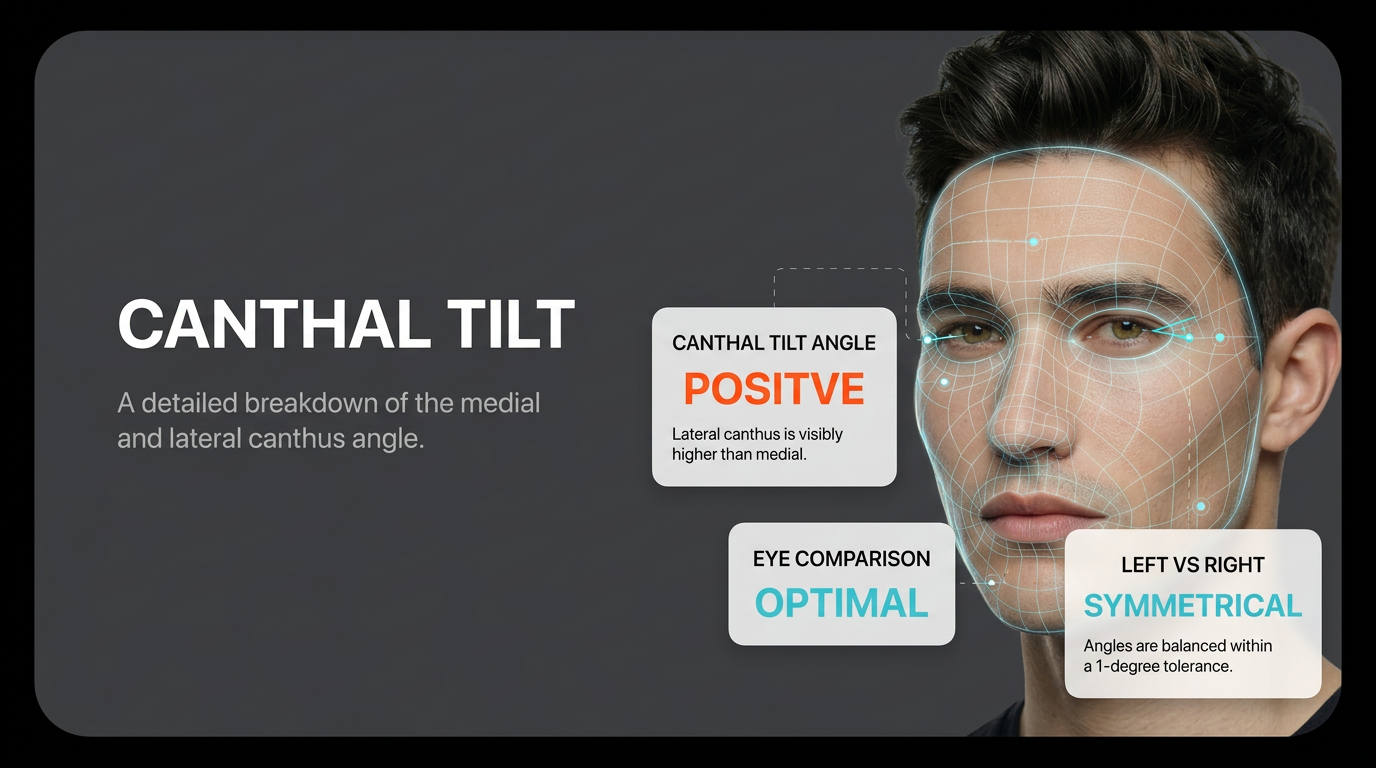
Positive Canthal Tilt vs Negative: The Aesthetic Comparison
Understanding the visual impact of different eye angles requires looking at how they function in the real world, rather than in isolated diagrams. Here is a breakdown of the three primary canthal orientations and how they affect overall facial perception.
- Positive canthal tilt: The outer corner sits higher than the inner corner. This creates a compact, alert appearance often associated with traditional masculine ideals. Verdict: Highly desirable in aesthetic modeling, but not strictly necessary for an attractive face.
- Neutral canthal tilt: The inner and outer corners sit on a perfectly flat horizontal plane. This provides a balanced, calm appearance that blends well with almost any underlying bone structure. Verdict: A solid, universally harmonious baseline that requires no correction.
- Negative canthal tilt: The outer corner drops below the inner corner. Without strong bone structure, this can create a sad, lethargic, or perpetually exhausted look. Verdict: Often viewed as a flaw in isolation, but easily offset and overpowered by prominent cheekbones and a strong jawline.
How Eye Shape Interacts With Overall Facial Harmony
Evaluating your eye angle in isolation is a deeply flawed approach to self-improvement. Facial aesthetics depend entirely on the structural relationship between multiple interconnected features. The overall symmetry and proportion of your face dictate how your eyes are perceived by others much more than the exact degree of your lateral canthus.
Research on regional facial asymmetries and attractiveness of the face confirms that overall harmony matters far more than the isolated angle of your eyelids. The orbital rim, which houses the eye, sits directly above the maxilla, or upper jaw. If your maxilla is well developed and projects forward, it provides crucial physical support to the lower eyelid and cheek tissue.
This strong foundational bone structure can make a neutral or slightly negative canthal tilt look intense and masculine rather than tired. This is a core concept covered extensively in the Face Maxxing pillar page. Conversely, if you have a recessed maxilla, the lower eyelid lacks support and drags downward, exposing more of the white sclera beneath the iris.
A study on the influence of mandibular prominence on facial attractiveness highlights how a strong jawline anchors the lower third of the face, drawing visual weight downward and making minor variations in upper facial eye shape largely irrelevant to overall attractiveness.
The Hard Truth About Natural Eye Reshaping
The internet is full of guides claiming you can achieve a positive tilt naturally through sheer willpower and physical manipulation. These claims rely on a fundamental misunderstanding of human anatomy. You cannot alter adult bone structure or tendon placement through topical treatments, facial exercises, or specific sleeping positions.
While the actual anchor points of your canthal tendons remain fixed to your bone, the soft tissue surrounding your eyes changes significantly over time. As men age, the production of collagen and elastin slows down, leading to a loss of skin elasticity. The orbital fat pads begin to shrink and descend with age. When this fat depletes, the skin around the lateral canthus loses its underlying scaffolding, creating the illusion of a negative tilt.
The bonesmashing myth. One of the most dangerous trends is the promotion of bone smashing, where individuals intentionally hit their orbital bones with blunt objects to induce remodeling. Maxillofacial surgical consensus is clear: blunt force trauma to the orbital rim causes micro-fractures, dense scar tissue, nerve damage, and potential blindness, not aesthetic enhancement. Never attempt to reshape facial bones through physical trauma.
The mewing misconception. Another common myth is that tongue posture practices will push the maxilla up and forward enough to change your eye angle in adulthood. The American Association of Orthodontists advises against mewing as a jaw restructuring intervention for adults, as noted in clinical reviews of Mewing (orthotropics). It will not magically lift your lateral canthus. You can read a full breakdown of this clinical evidence in Is Mewing Real? What the Clinical Research Actually Says.
- Strong evidence: Surgical procedures like canthoplasty physically detach and reattach the tendon, providing permanent alteration of the tilt.
- Weak or anecdotal evidence: Injectable fillers placed in the cheekbone area can sometimes provide a very slight, temporary illusion of lift to the lower eyelid, but they do not change the actual canthal angle.
- Community folklore: Facial exercises, skin taping, and sleeping on your back have zero clinical backing for altering the position of the lateral canthus.
Surgical Interventions: Canthoplasty and Canthopexy
If you are looking to permanently alter the geometric angle of your eyes, surgery is the only viable route. The lateral canthal tendon is a thick, fibrous band anchored directly to the bone. Altering this structure requires an oculoplastic surgeon, a licensed medical professional who specializes exclusively in the eyelids and orbital region.
Canthopexy. There are two primary procedures used to address a negative tilt. Canthopexy involves placing a permanent suture in the lateral canthal tendon to tighten and lift it without cutting the tendon itself. This is a less invasive option that offers more subtle results, often used to correct minor drooping caused by aging rather than structural genetics.
Canthoplasty. This is a highly invasive procedure where the surgeon actually detaches the lateral canthal tendon, repositions it higher on the orbital rim, and reattaches it to the bone. These procedures carry real medical risks. Over-correction can lead to an unnatural, pulled appearance, chronic dry eye, or severe complications with eyelid closure.
Sometimes, the issue is not the eye itself, but the underlying skeletal structure. A review of improvement in facial aesthetics of orthognathic patients after surgery-first approach notes significant aesthetic benefits when the foundational bone structure is corrected, which indirectly improves the soft tissue support for the entire eye area.
Realistic Case Walkthrough: The Surgical Route
To understand the commitment required for surgical alteration, consider this worked example of a typical canthoplasty patient. This is a constructed timeline based on standard oculoplastic surgical protocols, assuming a healthy 28-year-old male seeking structural correction for a severe negative tilt.
The consultation phase. The process begins with a specialized consultation. The surgeon evaluates the laxity of the lower eyelid, the anatomical position of the orbital rim, and baseline tear production. If cleared for surgery, the patient schedules the procedure, which is strictly cosmetic and not covered by insurance.
The procedure. The surgery takes roughly 1 to 2 hours and is usually performed under local anesthesia with intravenous sedation. The surgeon makes a precise incision at the outer corner of the eye, detaches the lateral canthal tendon, elevates it slightly, and sutures it securely to the periosteum of the orbital bone.
The immediate aftermath. The patient leaves the clinic the same day. For the first 48 hours, vision is heavily blurred from prescribed antibiotic ointments, and the eyes feel incredibly tight and gritty. Significant bruising and swelling are present around the lateral orbital rim, requiring constant cold compresses and strict rest.
What Progress Actually Looks Like During Recovery
If you undergo canthoplasty, the healing process is not instantaneous, and the initial results will look exaggerated and unnatural. Here is what progress actually looks like week by week as the tissue heals and the final aesthetic outcome emerges.
Week 1. Swelling peaks at 48 to 72 hours post-operation. The outer corners of the eyes will look overly elevated, often described as a severe, unnatural slant. Sutures remain in place, and the patient must sleep strictly on their back with their head elevated to minimize fluid retention and protect the delicate incisions.
Week 2 to 3. Sutures are typically removed around day 7 to 10. Bruising transitions from deep purple to yellow and begins to fade into the surrounding skin. The extreme tightness starts to relax, and the eyes begin to settle into a slightly more natural position. Dry eye symptoms are very common during this phase and require frequent lubricating drops.
Week 4 to 8. The vast majority of the residual swelling resolves. The lateral canthus drops slightly from its immediate post-operative position, settling into its permanent, final location. Expect visible change to stabilize over the following weeks, at which point the surgeon evaluates the final aesthetic outcome and clears the patient for normal physical activity.
How to Maximize Your Eye Area Without Surgery
Instead of obsessing over surgical interventions for minor perceived flaws, the most effective strategy is to maximize the variables you fully control. You can significantly improve the appearance of your eye area without ever going under the knife by focusing on grooming, skincare, and overall health.
Reduce facial bloat. Chronic fluid retention makes the lower eyelids puff up, dragging the visual weight of the eye downward and exacerbating a negative tilt. Lowering your overall body fat percentage and reducing sodium intake will sharpen your facial features and provide better visual support for your eyes. You can find more strategies for this in How to Get a Sharper Jawline: What Actually Works.
Optimize your skincare. Dark circles and poor skin texture draw negative attention to the eye area. Using a dedicated eye cream with caffeine can constrict blood vessels and reduce morning puffiness. Implementing a comprehensive routine from The Complete Mens Skincare Guide: From Zero to Glass Skin will improve the elasticity and brightness of the skin around your eyes.
Groom your eyebrows. The shape of your eyebrows heavily influences how the angle of your eyes is perceived. A straight, low-set brow with a slight upward angle at the tail can create the visual illusion of a more positive tilt. Keep your brows thick but neatly groomed to frame your eyes effectively.
Key Takeaways
Stop obsessing over millimeter differences in your eye area based on distorted smartphone selfies. Focus on the foundational aspects of your appearance that you can actually control, like your body fat percentage, skin quality, and overall grooming habits.
What to do next: If you want a realistic, objective look at your facial harmony without the internet toxicity, start by getting a personalized plan. Focus on actionable steps like optimizing your skincare routine, lowering your body fat, and hitting the gym before you ever consider going under the knife.
- Canthal tilt is the anatomical angle between the inner and outer corners of your eye.
- A slight positive tilt often signals youth and alertness, while a negative tilt can create a tired appearance.
- Your eye angle is determined by the physical attachment of the lateral canthal tendon to your orbital bone.
- Smartphone cameras distort facial features, making self-measurement highly inaccurate.
- Surgery is the only proven method to permanently change your eye angle, and it carries significant medical risks.
- Overall facial harmony and a strong jawline matter far more than the isolated angle of your eyes.
FAQ
What is a normal canthal tilt for a man?
A slight positive tilt is the anatomical norm for most men. Extreme angles, whether highly positive or severely negative, often look unnatural and disrupt overall facial harmony.
Can I change my canthal tilt naturally?
No. Your eye angle is determined by the physical attachment of a tendon to your orbital bone. Facial exercises, sleeping positions, and skin pulling cannot move this anchor point.
Does a negative canthal tilt make you ugly?
Not necessarily. Facial attractiveness relies on overall harmony and symmetry. Strong bone structure in the jaw and cheekbones can easily offset a negative eye angle.
How do I measure my eye angle accurately?
You need a photograph taken from at least five feet away with a standard or telephoto lens while your head is perfectly level. Selfies cause barrel distortion that makes the outer corners look artificially droopy.
Is canthoplasty safe?
Canthoplasty is a surgical procedure with real medical risks, including over-correction, dry eye, and eyelid closure issues. You must consult a board-certified oculoplastic surgeon to evaluate these risks.
Does mewing fix a negative canthal tilt?
No. The American Association of Orthodontists advises against mewing as a jaw restructuring intervention for adults. It will not push your maxilla forward enough to lift your lateral canthus.
Why do my eyes look droopy in selfies?
Smartphone cameras use wide-angle lenses that distort the center of the face and pull the outer edges downward. This focal length distortion makes your eyes appear more negatively tilted than they actually are.
LooxMaxxing
Stop guessing. Get your real rating.
Upload three photos, answer the assessment and get an AI facial rating with a personalized improvement program.
Take the free assessmentAbout the author
LooxMaxxing EditorialEditorial
Articles from LooxMaxxing about appearance, grooming, skincare, hair, training and lifestyle.
Keep reading
What Are Hunter Eyes? Anatomy, Genetics and Reality
Discover the anatomy behind hunter eyes, how genetics shape your face, and the honest truth about what you can actually change. Get your personalized plan.
AI Rate My Face: The Honest Truth About Algorithmic Scores
Curious if an ai rate my face tool is accurate? Discover how facial algorithms work, where they fail, and why your score does not define your looks.
Is Mewing Real? What the Clinical Research Actually Says
Wondering is mewing real? We separate clinical facts from internet myths, explain the real risks, and show what actually works for jawline aesthetics.
Medical disclaimer: this article is general information about appearance, grooming and lifestyle habits. It is not medical advice, diagnosis or treatment. Talk to a licensed doctor, dermatologist or dentist before starting any medication, procedure or treatment, and never attempt surgical or orthodontic changes on your own.